Mallusjoki pilot’s aim is to gather a stakeholder panel and carry out actions which will add value to all participants. The pilot builds on Social Exchange theory which is a concept based on the idea that social behavior is the result of an exchange process. Social exchange is cooperation for mutual benefit. It is an “I’ll scratch your back if you scratch mine” principle. In any case, Mallusjoki pilot builds upon long-term stakeholder relationships and the pilot has a policy, tolerance and patience to wait for the pay-back.
The following two Mallusjoki pilot stakeholder meetings are about Smart Villages concept and synergies in the regional cultural events
The aim of the consultation meeting was to get first-hand information from the main authorities about the policy and strategy for implementing the Smart Village concept in Finland. The take-away was that the Ministry is committed to promoting the Smart Village concept and that there are also funds in the budget.
The authorities and agencies responsible for implementing the Smart Village strategy are looking forward to receiving innovative and practical ideas and funding applications from the villages.
Building synergies with cultural heritage projects in the Päijät-Häme region
The stakeholder member present was Joonas Pokkinen from the Regional Council of Päijät-Häme. He leads several regional cultural heritage projects. He is well informed about regional policies and strategies in the field of cultural heritage. Our discussion touched on possible synergies at policy and project level.
The following conclusions were drawn:
Päijät-Häme Regional Council promotes coordination of cultural work between municipalities
The PoliRuralPlus project and the Mallusjoki pilot project see advantages in linking up with other cultural projects in the region.
An interesting benchmark case is the Community Event Arena in the village of Jaala, which aims to promote cultural life in the village through a new arena. The investment was 1 MEUR.
Many EU funded projects have grasped the idea to involve different stakeholder groups into the project execution. The multi-actor approach and quadruple helix model have became a real tool and concept for project managers.
The idea is to promote diverse stakeholder groups participation into project planning and implementation. Stakeholders provide insights and feedback to project execution. They guide it as an local Advisory Board. When it comes the time to exploit the project results, the active and powerful stakeholder members become agents and ambassadors to amplify project activities on replication and exploitation of results.
In the INTERREG Baltic Sea Region project Change(K)Now! we aim to impact on food packaging practices in the institutional catering value chain.
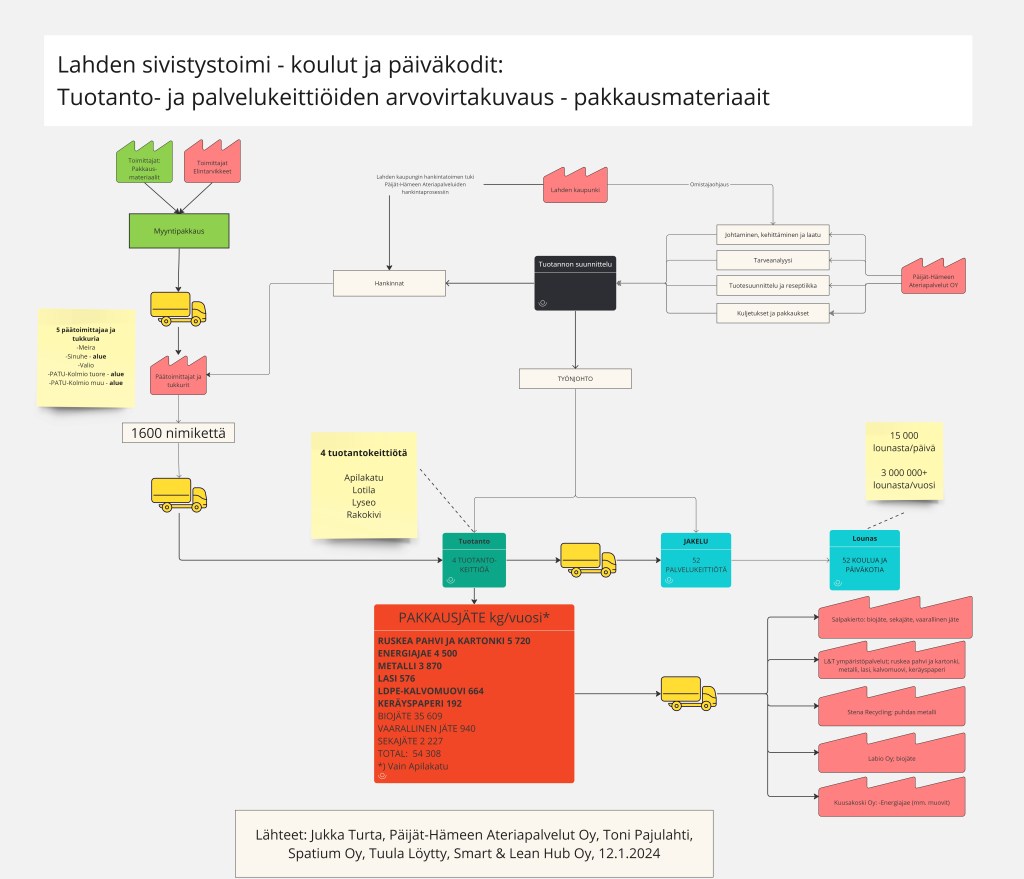
The value chain mapping (see the pic below) assists to identify the relevant stakeholder members who have interest of and power to influence on the institutional catering value chain. In the project we explore the material- and associated information processes, as well as we aim to grasp the overall management principles and policies associated to the institutional catering value chain.
The value chain map of the institutional catering in Lahti primary schools and kindergarten, 2024
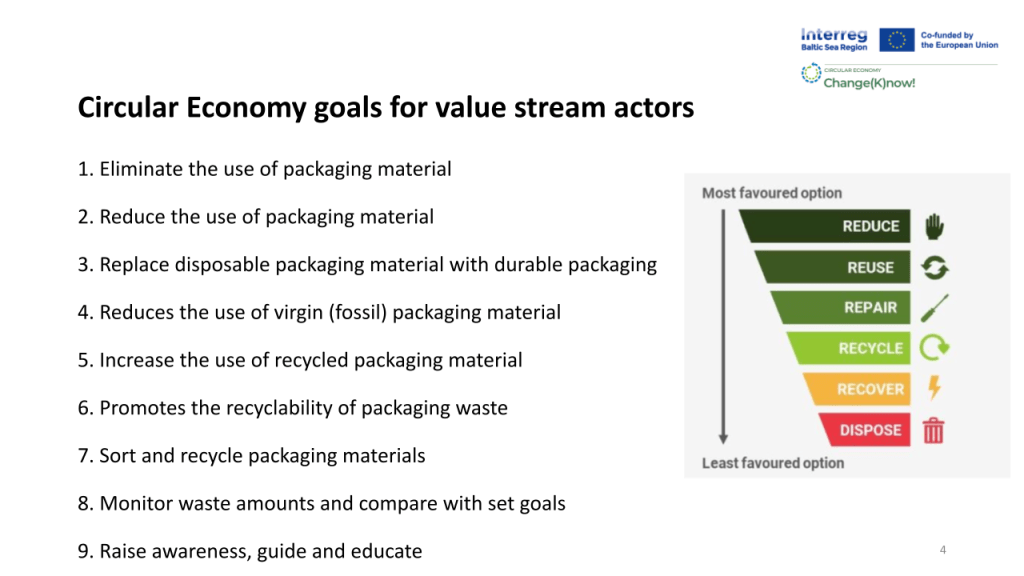
The project team together with stakeholders has defined the following Circular Economy goals for the value chain of the institutional catering in Lahti primary schools and kindergarten.
Based on Google Scholar database the number of published papers that include the term “Black Soldier Fly larvae” has increased since 2015. A new record will be made by the end of 2020, as 449 papers are already published in the first 8 months (Figure 1).
Figure 1: The number of papers that mention “Black Soldier Fly larvae” and are published on Google Scholar
What is Black Soldier Fly larvae and what is it capable of?
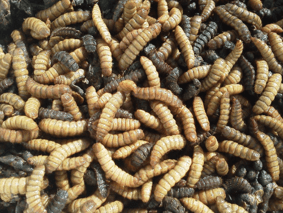
Hermetia illucens i.e. the black soldier fly, is a common and globally widespread fly.The adults of Hermetia illucens measure approximitely 16 millimetres long.Back Soldier Fly (BSF) larvae are used to compost waste or convert the waste into animal feed. It’s a bio-converter. Fly larvae are among the most efficient animals at converting feed into biomass. One larvae is able to eat about 130 mg food waste daily. Unfortunately the life of greedy larvae is short, perhaps 2 weeks hence the BSF farming requires constant upkeep. The other reason to farm BSF larvae is that the fat larvae is an excellent source of protein both for humans and animals.
Figure 2: Black soldier fly larvae
Black Soldier Fly larvae and RDI actions
There is no lack of wicked problems: the need for economic opportunity, growth and development in rural areas; the problem of disposing of millions of tons of food waste generated in both rural and urban settings each year; a risk for hunger pandemic, a need for high-quality protein products both for food and feed.
The problems are so big that there is no chance to leave any stone unturned. Researchers world wide have since 1999 researched, tested and experimented how to farm BSFs and larvae of BSFs. The researchers have tested BSF larvae’s ability and limitations to be an efficient bio-converter. They have studied the business models of bio-conversion and also BSFs’ usage as a protein source. Technical upscaling from laboratory scale to industry scale business has been simulated and prepared.
The investments in the last decade on research, development and innovations actions have opened avenues to eager entrepreneurs, particularly in rural settings, to establish BSF larvae based production and business that relies on evidence and research results. In addition to scientific papers the diverse research actions have hopefully also advanced networking, co-operation, knowledge transfer and cross-sectorial understanding of Insect Economy.
Black Soldier Fly larvae and the wider concept of Insect Economy may provide a case to analyse policy makers’ influence on past RDI actions:
How weak signals have been noted in?
How RDI funding has been addressed to?
How entrepreneurs have been supported?
How food/feed legislation and regulation has adapted into the domain?
How policy makers and governance have participated in networking, ecosystem building and cooperation?
From science to practice and viable business
There is still a lot of work to do to direct BSF larvae farming and Insect Economy into serious new business to benefit rural areas and to create new jobs. The main limitation to make business of BSF seems to be the markets. The protein products for food or feed still need customer acceptance and routes to markets. In addition, the larvae ability to process waste e.g. mixed food waste or manure is unexploited in the industrial scale. The waste handling processes (e.g. biomass collecting), the business models and production technology are not ready for that.
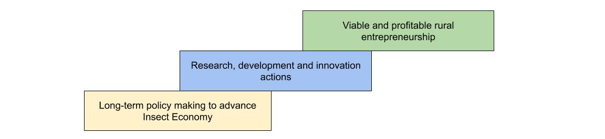
In order to enhance further developments in Insect Economy, the policy decisions that direct practise-oriented RDI actions, are based on evidence and are timely, give a push to new rural entrepreneurship (Figure 3).
Figure 3: Policy making has a role to enhance rural entrepreneurship
Blue Wings Composting experiment
Blue Wings Composting experiment kick-off has taken place in August 2020. Smart & Lean Hub Oy manages the experiment that aims to recycle low-grade food bio-waste by using 10 000 Black Soldier Fly larvae. The experiment and its extensions (e.g. Sciences Cafes and visits) are carried out with Länsiharju school class 10-year old children, Lappeenranta-Lahti University of Technology (LUT), Natural Resources Institute Finland (LUKE) and Päijät-Häme STEM-center.
Blue Wings Composting experiment is part of the environmental project – Lahti – European Green Capital 2021 which aims to create innovation and improvement in environmental issues, such as recycling, energy production and awareness.
In co-operation with Lappeenranta – Lahti University of Technology (LUT) SIRKKA project – New business from sustainable insect based protein production


 Smart & Lean