Categories
Bokashi Horizon2020-CITIES2030 Yleinen

Experiment 1: Bokashi – Food waste bio composting

Lahti Living Lab carries out an experiment: Bokashi – Food waste bio composting.  The coordinator of the lab is SLEAN (P14).  

The experiment was initiated in June 2022 and it was closed by the end of September 2022.  The ideation phase took circa half a month in June. The building phase which overlapped ideation and monitoring lasted from the middle of June until the end of July.  The monitoring phase lasts from the middle of June until the end of September.    The learning phase lasted from July until the end of September. 
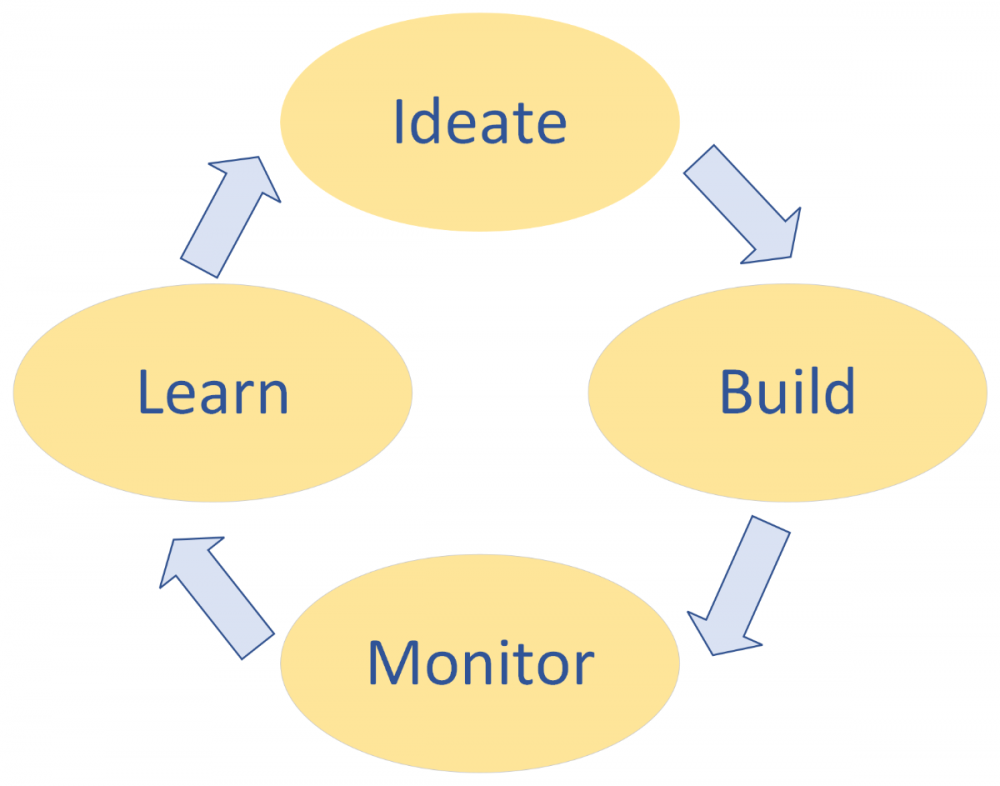
image.thumb.png.8bffac20e3b4912bb609d5a5cfd78ef2.png

1. CRFS Vision 2030 and the challenge

Lahti Living Lab carries out innovation actions that contribute to EU, city of Lahti,  and Cities2030 visions and objectives.  

  • EU Food 2030 policy: Nutrition for sustainable and healthy diets. Food systems supporting a healthy planet. Circularity an resource efficiency. Innovation and empowering communities
  • Lahti vision 2030: Sustainable and carbon neutral city region
  • Cities2030 objective: Enhance circularity and local food belts

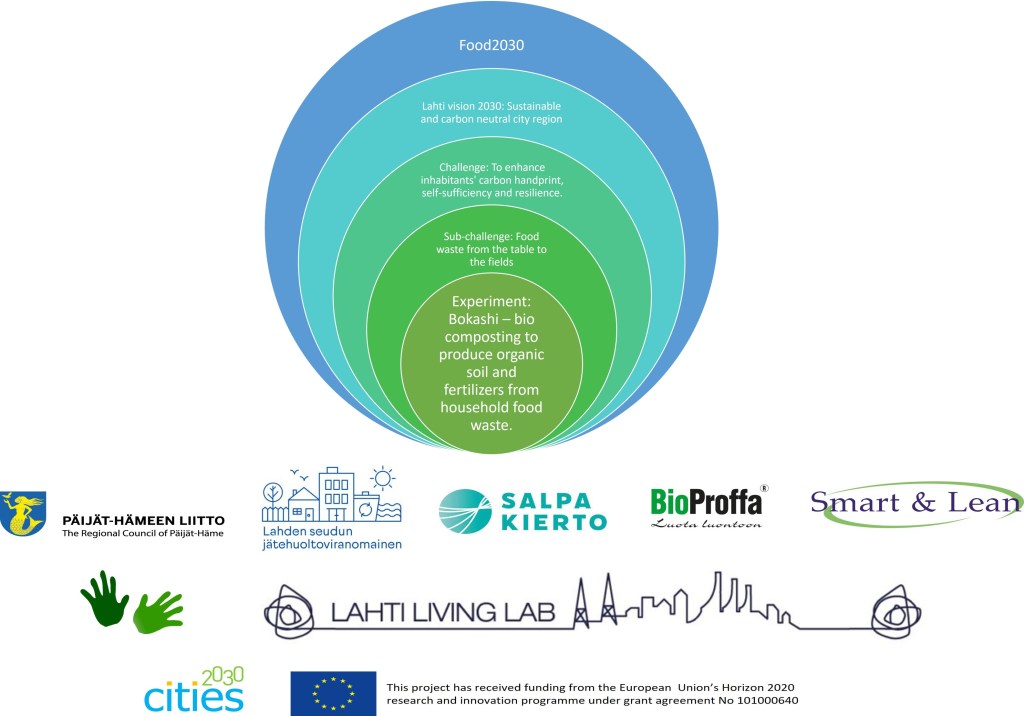
The Lahti Living Lab’s experiment at Cities2030  is “Bokashi – Food waste bio composting”. Its objective is to explore bio-composting food waste from the table to the fields to enhance inhabitants’ positive carbon handprint, self-sufficiency, and resilience.

See figure 1. 

2. Key change drivers 

The general and individual change drivers are listed in figure 1.  The list of general change drivers is developed based on an analysis of EU-, national- and regional initiations and actions.  They are for example set EU, national and city goals, new recycling and bio waste legislation and regulation.  The list of individual change drivers is a summary of experiment participants’ motivation factors. 

The 10 experimentalists replied to the survey about which of the listed change drivers were in their opinion the most relevant and important. Which change factors influence most of their thinking and behavior?. The most influential change factors are all linked to the experimentalists’ subjective benefits: reducing the cost of public waste management, enhancing awareness and capacity, getting organic and rich soil and fertilizer, enhancing home garden growth and wellbeing, and disposal of food waste in an ecological and easy manner.   The key change factors are noted in figure 1 with a red tag.

779687712_Bokashivisionsobjectivesdriversandnudges(4).thumb.jpg.f1cf7184b074cc59deef859aff6e8823.jpg

Figure 1: Experiment 1: visions, objectives, change drivers and nudges. 

4. Multi-actor nudges and interventions to promote food waste bio composting and bokashi 

4.1. Nudge 1: Establish a community of practice 

The bokashi experiment of Lahti Living Lab target group is wide, not by quantity but by coverage of the target group. The experiment aims to engage and influence on following actors:

  • 10 experimentalists (see the youtube video below) 
  • 2 experts of experience 
  • Regional policymakers:  Päijät-Häme Regional Council
  • City of Lahti policymakers: Lahti Region Waste Management Authority
  • The public body that in practice is handling the food waste: Salpakierto Oy
  • Academia: University of Oulu
  • Business: BioProffa/Esbau Oy
  • Other inhabitants

In addition to the above stakeholders, the experiment has looped other stakeholders and experts that represent e.g. horticulture, microbiology, food advisory, capacity building organization, and urban greening planning expert. Totally 27 people are considered to be in the communication loop.

The experiment aims to engage and impact simultaneously all engaged actors.  The aim is to create actionable conditions (policymakers, policy implementers), obtain objective evidence of the applicability and effects (researchers), explore and uptake functional bokashi process (process know-how, goods, and consumable suppliers), and finally learn and test food waste bio composting in households.   

The below youtube video presents the 10 experimentalists who received their new bokashi buckets in June 2022: https://www.youtube-nocookie.com/embed/3GOY8cEIIe8?feature=oembed

4.2. Nudge 2: Bokashi buckets and starters guidance

All 10 experimentalists received a bokashi package and starters’ guidance in June 2022. 

4.3. Nudge 3: Analysis of bokashi drivers and obstacles 

At the beginning of the experiment, a deep dive into bokashi change drivers and obstacles was conducted.  The purpose of the analysis was twofold: firstly to find out the subjective motivational factors of the experimentalists,  but also to extend their know-how of the EU, national and local change drivers which are typically related to the legislation and regulation.

image.thumb.jpeg.1c8ba40e8713a647f39dcc53e4dcf497.jpeg

Figure 2: Bokashi change drivers and obstacles

The aim of the exercise was also to identify which of the change drivers may have an impact on the systemic transformation of the City Region Food System (Figure 3). We identified that new waste management, particularly bio waste, regulations and laws affect food waste management,  models, and structures. Also, the availability of bokashi and bio-composting goods and equipment paves the path to transformation. In a summary, the regulations urge us to consider starting bio-composting in households, and on the other thanks to equipment, the threshold to start bio-composting is lower than before.  This situation is the starting point for the bokashi experiment. 

image.thumb.jpeg.f9f70fccb4652aa3ca42c6cff780470c.jpeg

Figure 3: Legislation, regulation and facilities to enhance urban food waste management 

4.4. Nudge 4: Online peer support 

The activation of the low-threshold Whats App group enables peer support among experimentalists.    

4.5. Nudge 5: Online expert by experience support 

The engagement of 2 Experts of Experience in the group appeared to be truly a value-adding nudge.  They supported the experimentalists,  and brought in their practical know-how of the bokashi process.   

4.6. Nudge 6: Social media visibility and public experiment 

The experiment was communicated and shared in Facebook, Linkedin, Twitter and Instragram by experimentalists, by other stakeholders and by the coordinator of the experiment.  The aim was to create encouraging pressure on the experimentalists and bring out their positive handprint on food waste management.   

4.7. Nudge 7: Self-reflection on bokashi experiment

All 10 experimentalists are committed to delivering 2 either blogs or video in which they reflect on the experiment.  The submission deadline is the end of September 2022.  The deliverables are saved into http://www.smartlean.fi web page and distributed through social media. https://smartlean.fi/category/bokashi/

4.8. Nudge 8: An initiation for public bokashi course

At the Lahti region, there has been no offering of a bokashi course by any institution.  The plan to start a short course next spring or latest 2023 autumn is in the process. The course will contribute to raising awareness and building capacity for bio-composting and bokashi.

4.9. Nudge 9: Matchmaking urban agriculture and Urban Greening Plans

In the Lahti region, urban agriculture is modest and practices are undeveloped.  However, the city supports the rent of allotments by providing the land areas. Urban agriculture is part of the Urban Greening Plans that municipalities are required to deliver. It’s part of the European Green Deal and EU Biodiversity Strategy 2030.  The experiment coordinator has communicated with a body (SYKE) that contributes to the development of Urban Greening Plans at the national level. The aim is to influence the city of Lahti to update the Urban Greening Plan and integrate urban agriculture into the content. 

4.10. Nudge 10: Contribution to the ongoing academic research

Biodiverse Anthropocenes is a Research Programme of the University of Oulu supported by the Academy of Finland PROFI6 funding (2021-2026). This innovative and transdisciplinary research initiative brings together scholars from across the social and natural sciences to collaboratively investigate the biodiversity loss currently threatening multi-species well-being and planetary sustainability, and to generate future-oriented solutions both in the Arctic and around the planet.

Bokashi bio-composting is considered in the research program as a mode of urban waste management.  Lahti Living Lab bokashi experiment has given a tiny input to the program.  The Bokashi experiment is one of the ongoing local case studies in Finland.

4.11. Nudge 11: Lobbying to harmonize national urban food waste procedures on bokashi

Due to the novelty of bokashi and also to the recent update on bio-waste management law, the waste management authorities’ practices related to bokashi vary in different regions in Finland.  The aim is to influence firstly local waste management authorities’ insight and interpretation so that it gives an opportunity to carry out the bokashi type of bio composting solutions.  The second aim is to communicate the different practices to show the variation. . 

4.12  Nudge 12: Capacity-building event 25.8.2022 

The below youtube video allows you to peek at the capacity-building event that was arranged by Lahti Living Lab on Thursday 25.08.2022 at the idyllic premises of Ahtiala Old Railway Station. Nearly 20 women share knowledge, experiences, and insights on food waste recycling, bio-composting, and bokashi composting.
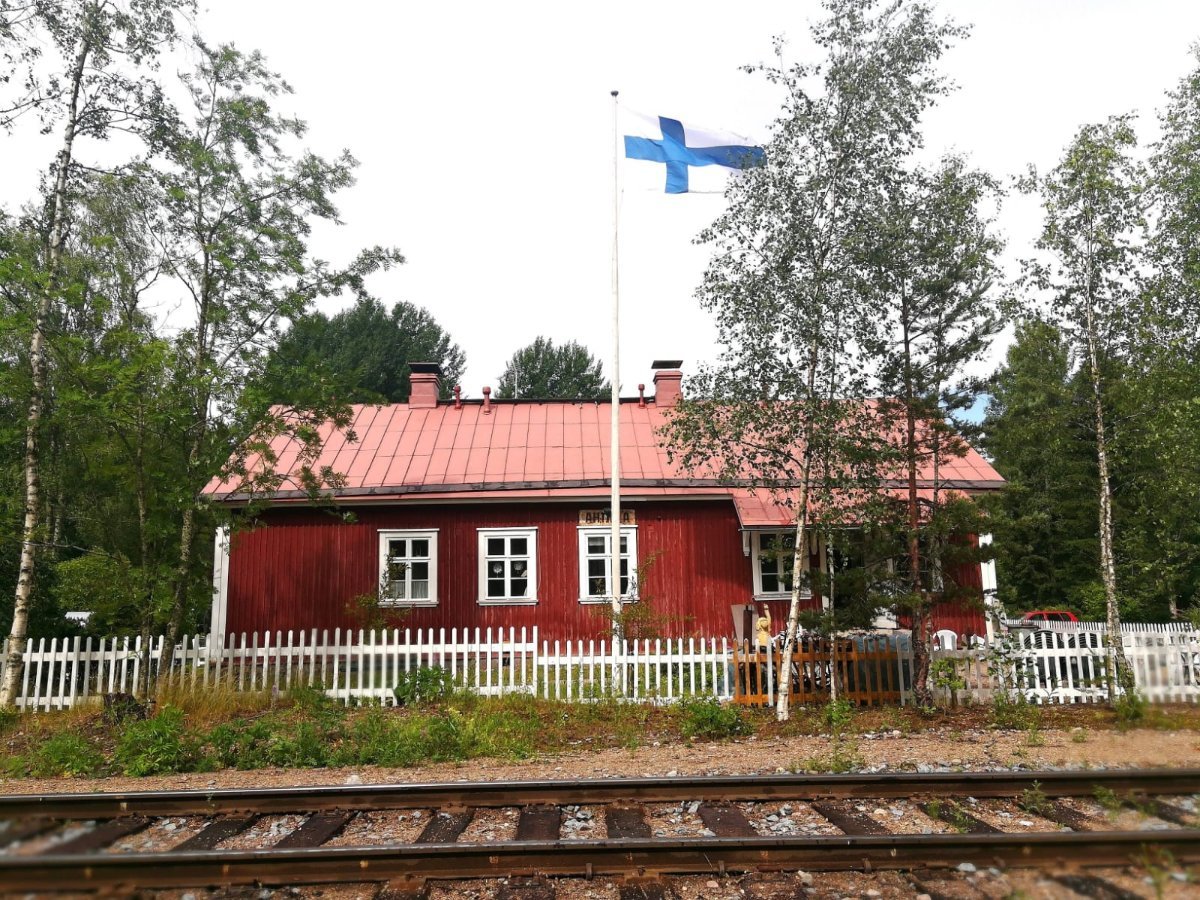
image.thumb.jpeg.0ed294b7caf1000fe7c107a5851e8a1a.jpeg

Figure 4. Capacity-building event at Ahtiala old railway station

https://www.youtube-nocookie.com/embed/TnZqFnLTSbQ?feature=oembed

5. Innovation actions and results 

5.1 Lahti Living Lab’s innovation actions, results, and analysis of results  

Innovation actions: 

image.png.944c6b5f38bc94911dd24a28012779eb.png

Innovation actions aka experiment’s results:
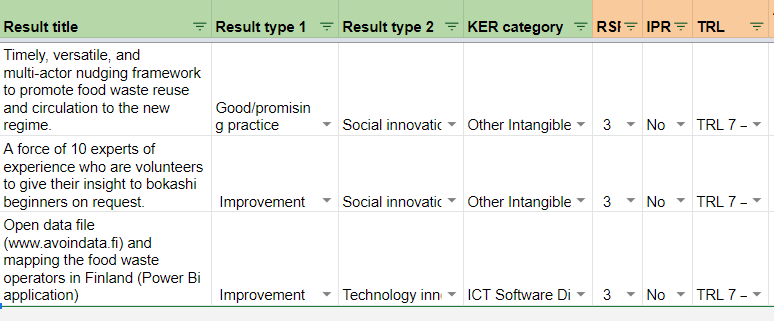
image.png.9c1a9fc4fa8e377b19922dddaad79b59.png

5.2 Anticipated and actual action per SMART Goals  

The four first indicators are on the city, region or national level.  In short term, the experiment has no impact on them.  In long term – 5 years – the enhanced bio composting solutions, including bokashi, has an impact on the three first indicators, but the main reason for the transition is the improved laws and regulations.   Bokashi experiment raises awareness of the importance of soil in food production and household gardens,  and thus in a tiny way impacts food self-sufficiency in Finland. 

The other indicators in the table are directly linked to the implementation of the experiment.  Only one goal was not achieved, which is the goal to deliver innovation. The other goals were achieved or exceeded.

image.thumb.png.def8c13ab3bd731767b4d6c7ddc10454.png

6.  Expected impacts 

The result aims to influence research, policymakers, policy implementations, and capacity-building institutions. They have a key role to raise awareness of different food waste management solutions that households can and will apply.  After 5 years, inhabitants will separate better the biowaste than today. Those who are able to bio-compost by using isolated heat composters are the mainstream. But there is also room for those urban citizens who want to show their positive carbon handprint and process their food waste into enriched organic soil and fertilizer. For them, bokashi bio-composting will be a well-known, available and feasible solution.

The reuse of food processing residuals in the household gardens to renovate soil and enhance plant growth and yield has an impact on inhabitants and city regions.  The impact reflects on inhabitants’ empowerment, resilience, and self-sufficiency in urban agriculture and food production. It has positive impacts also on biodiversity. Urban agriculture binds carbon which fosters carbon neutrality and thus mitigates climate change.  

7.  Additional material 

Categories
Bokashi CITIES2030 Horizon2020-CITIES2030

Kokemus Bokashi- kompostoinnista 

Tämän blogin on kirjoittanut Sirkka-Liisa Kaukanen. Hän osallistuu Lahti Living Lab:n toteuttamaan bokashi kokeiluun kesän ja syksyn 2022 aikana.


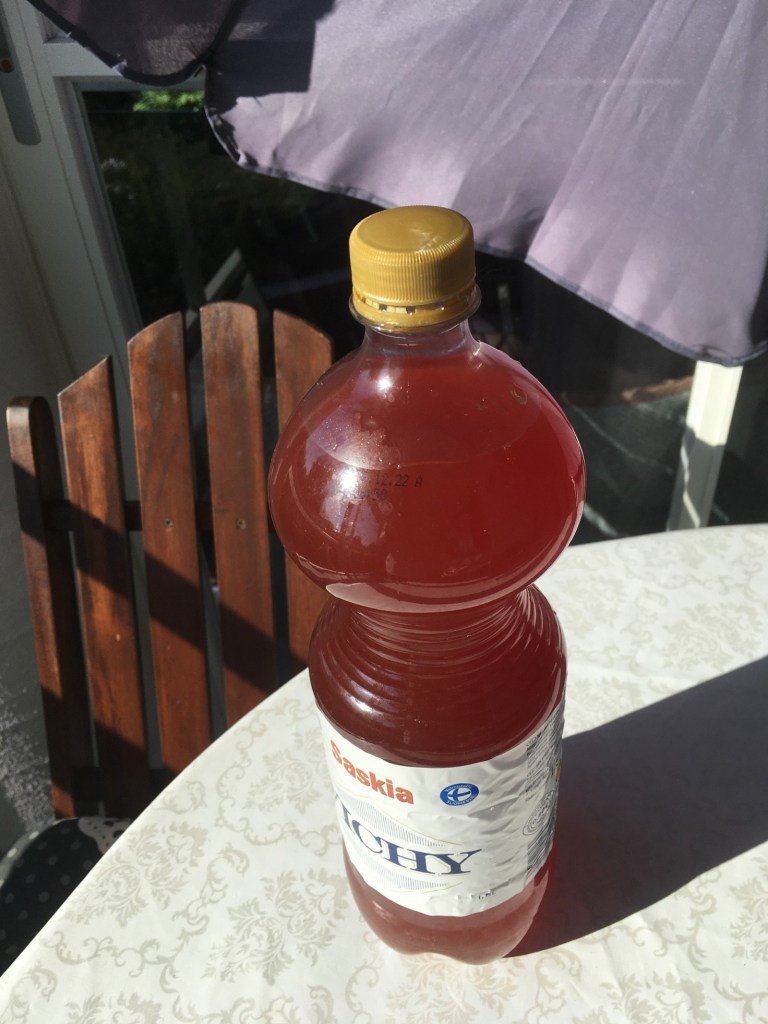
Pari kuukautta alkaa olla bokashointikokemusta. Keittiöjätteitä onkin syntynyt mukavasti marjastuksen ja sienestyksen myötä. Erityisen runsaasti on syntynyt bokashointinestettä pihakasvien lannoitukseen. Nestettä tulee niin runsaasti, että sitä voi tuottaa myös naapurille.

Lämpimän sään ansiosta olen säilyttänyt astioita lasitetulla parvekkeella. Välillä tosin olen epäillyt, että tila voi olla ajoittain liian kuuma hellesäillä. Bokashoinnista on tullut hauska tapa, johon olen innostunut.Tiiviit astiat ja Bokashi-rouhe estävät hajuhaitat. Banaanikärpäsetkään eivät ole haitanneet tänä kesänä marja-aikaan.

Fermentoinnista on huomattavaa hyöty verrattuna tavalliseen kompostointiin.

Aiemman kokemuksen mukaan käyttäen lämpökompostoria olen tutkiskellut kompostointieneroja. Bokashoinnin fermentoinnissa hyödynnetään mikrobitoimintaa, jonka ansiosta hapatettu biomateriaali säilyttää kasvien tarvitsemat ravintoaineet, kuten typen valmiissa mullassa. Näin multa on ravinteikasta ja sopii hyvin kaikille kasveille. Näin ei tarvitse ostaa kaupasta ravinteita. Multa kuten biojätekin tuoksuu raikkaalta.

Lämpökompostorissa multa ei ehdi tekeytyä käyttökelpoiseksi vuoden aikana. Joka talvi kompostori jäätyy ja odottaa kevään aurinkoa sulattamaan sisältä. Toisinaan kompostoriin voi kehittyä homettakin, jos bakteerit tai sienet saavat yliotteen. Lämpökompostorissa näkyy pieniä ötököitä ja/tai matoja kantta avattaessa. Kaipa ne tekevät siellä omaa työtään. Bokashointiin verrattaessa keittiöjätteitä voi viedä päivittäin ja sekoittaa mukaan aina kuiviketta.  Kompostorihan ei ole ilmatiivis ja sen ilmastoinnista/tuuletuksesta on huolehdittava, ettei sisältö ala mädäntyä. Usein huomaa kuitenkin sisällön olevan liian kosteaa, kuivikkeesta huolimatta, jolloin kompostointi ei edisty kunnolla. Poistoputki kyllä työntää liiat nesteet ulos.

Ainakin opin, ettei bokashiastiaan kannata laittaa kahvin suodatinpusseja, kun ne eivät fermentoidu ja näkyy vielä ajan kuluttuakin multakompostorissa. Myös biojätteet kannatta pilkkoa mahdollisimman pieniksi, jotta astian saa täytettyä ilmatiiviisti.

Kokemukseni mukaan pidän bokashoinnista enemmän kuin lämpökompostorista, mikä ei ole tuottanut näin nopeasti raikasta multaa. Yllättävän paljon multaa syntyy muutamasta sangollisesta. Kaiken kukkuraksi multa on vielä ravinteikasta. Innolla jään odottamaan tuottamani mullan siirtoa ensi keväänä lavakauluksiin.


Tämän päivän annos bokashointinestettä kasvien ravinnoksi.


Categories
Bokashi CITIES2030 Horizon2020-CITIES2030

Ajatuksia Bokashi- kompostoinnin tiimoilta

Tämän blogin on kirjoittanut Sirkka-Liisa Kaukanen. Hän osallistuu Lahti Living Lab:n toteuttamaan bokashi kokeiluun kesän ja syksyn 2022 aikana.


Sain kesäkuussa 2 Bokashi astiaa ja kompostointiaineet Tuula Löytyltä juhannuksen jälkeen. Olin utelias bokashointi-menetelmästä. Aiemmin minulla on ollut kaksikin Biolanin lämpökompostoria puutarhajätekompostorin lisäksi. Silti puutarhajätettä on viety Kolavalle joka vuosi. Joskus olen joutunut laittamaan myös sekajätteeseen ruokajätettä – ja sehän on tuntunut pahalta! Usein olen pohtinut kuinka ne omat puutarha- ja ruokajätteet saisi helposti itse kompostoitua – TUOTTAVASTI.

Valitettavasti Suomen olosuhteissa lämpökompostorista ei ole juuri hyötyä talviaikana sen jäätyessä. Sähkölämmitystäkin siihen on ehdotettu, mikä ei ole mielestäni ratkaisu tällaisena energiapulan aikana. Oksat olen silpunnut katteeksi pensasaidoille ja perennapenkin kuihtuneet kukanvarret olen laittanut puutarhakompostoriin. Usein kuitenkin keväällä mies on sen tyhjentänyt ja vienyt maatumattomat jätteet Kolavalle.

Nyt virisi uusi toivo kompostoinnin suhteen.

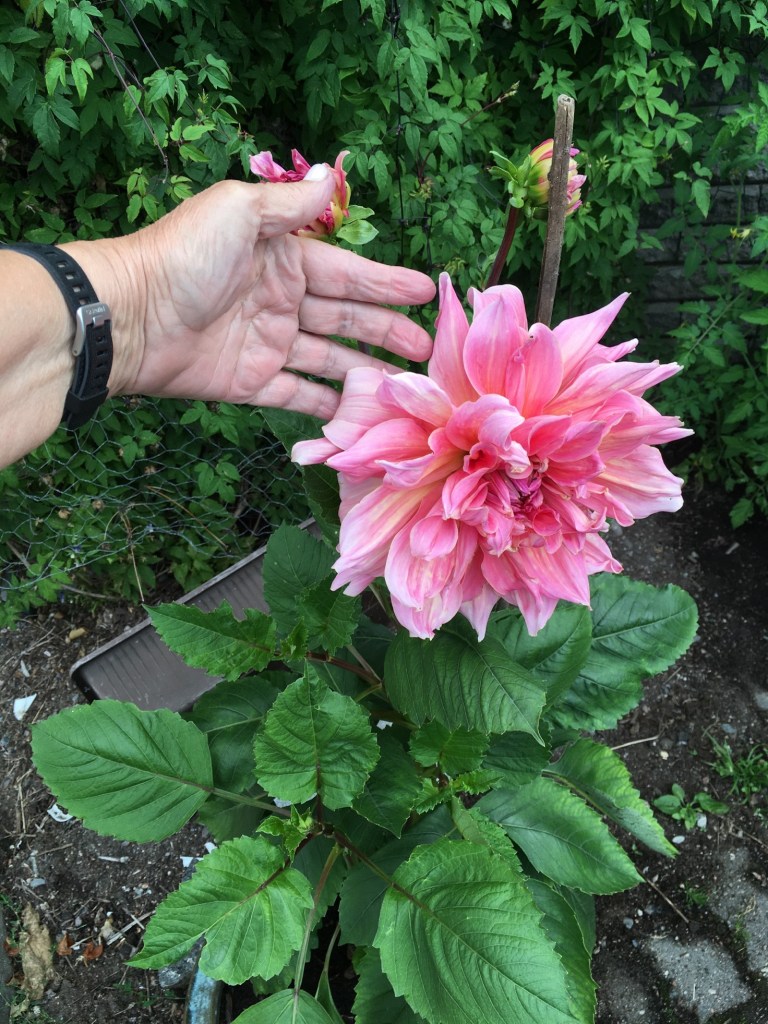
Juhannuksen jälkeen kävin hakemassa ison laatikon Tuulalta. Kotona avasin uteliaana laatikon. Sisällä oli kaksi kaunista kompostointisankoa. Mukana oli myös kompostoinnin lisäaineet ja mitta-astiat. Luin mukana tulleet ohjeet tarkkaan. Sitten vaan astiaa täyttämään. Välillä liruttelin nestettä kukkien lannoitteeksi. Sitähän tulikin 7 mitallista ensimmäisestä astiasta parin viikon aikana. Haju oli kyllä aika epämiellyttävää. Kaipa se oli juuri niin voimakasta. Laitoin sitä kastelukannuun ja kastelin vesiseoksella pioneja ja daalioitani sekä tomaattejakin. Kukat kasvoivat hyvin ja kauniit kukat puhkesivat kukkaan. Aine todellakin on hyvää ja edullista kasvien lannoitetta.

Parin viikon aikana ensimmäinen astia täyttyi ja laitoin sen fermentoitumaan. Fermentoitumisen jälkeen tuli aika sekoittaa se multaan vanhassa kompostorissani. Samaan aikaan täyttyy toinen sanko pikavauhtia, kun on marja-aika.

Parin viikon kuluttua oli jätteet sekoittuneet mullan seassa erinomaisesti. Multa oli hyvän näköistä. sekoittelin vielä hyvin ennen toisen sangollisen lisäämistä.


Tämä blogi liittyy Lahti Living Lab:in Bokashi-kokeiluun, jossa uudet bokashoijat testaavat ja oppivat Bokashi-biokompostointia.

Kokeilun tavoitteena on tunnistaa kotitalouksien ruokajätteen biokompostoinnin tekijöitä, mahdollistajia ja esteitä sekä suunnitella ja testata parannuksia, käytäntöjä ja ratkaisuja kotitalouksien biokompostoinnin edistämiseksi. Bokashi-kokeilu edistää asukkaiden hiilikädenjälkeä, omavaraisuutta ja joustavuutta.

Lahti Living Lab:n toimijoita ovat myös Lahden seudun jätehuoltoviranomaiset ja jätehuoltoyhtiö Salpakierto Oy. Yhdessä he ohjaavat biojätteen käsittelyä alueella. Lisäksi Esbau Oy, joka on BioProffa-laitteiden jälleenmyyjä, osallistuu toimintaan. Päijät-Hämeen Liitto edistää alueellisesti ruokajärjestelmän muutosta kestävämpään suuntaan.

Bokashi-kokeilun rahoittaa Horizon2020 projekti Cities2030.

Categories
Bokashi CITIES2030 Horizon2020-CITIES2030

Bokashi in the urban food system

The blog is written by Liisa Karlsson in July 2022. It is associated with the Lahti Living Lab Bokashi bio composting experiment and Cities2030 project.


Originally from Japan, the bokashi method has the potential to reduce and utilize food waste. Introducing the method to the public does not come without its problems.

Although fairly low maintenance, not foolproof. Perfecting the bokashi process takes knowledge of the right bran to scraps ratio, draining the noxious liquid and moisture level, for example. For bokashi composting to become common in urban housing, more education and public information resources are needed.

Where should people in urban settings use the compost? Everyone doesn’t have access to their own garden and house plants need only so much new soil. In addition, the fermented waste isn’t technically completely ready after it’s taken out of the bokashi container, it needs to be further processed in the soil composting unit where it breaks down fully. This step is a major problem for some urban living situations. Hence a city or housing unit would need a common final composting destination. Ideally, this destination would be within walking distance of the housing, but in case it’s not would the transferring of the compost happen with a refuse collection vehicle. This would reset the waste transfer emission reduction. So why should we transfer the responsibility of biomass composting from the waste treatment facility to the public by bokashi if, in the end, the facilities need to step in anyways? 

Maybe we need to renovate the waste system altogether by taking inspiration from the electricity market. What if urban dwellers could sell the produced compost to the waste management industry so that they could forward the compost to gardens and agriculture. Much like we can sell solar energy back to the electric power network. In large enough quantity this could be extremely beneficial for horticulture and agriculture and soil quality. The small reward for composting could work as an incentive for composting. On the negative side, this would lead to multiple transferring trips adding to the emissions.

So, I see two major problems for the bokashi revolution, logistics, and education. If those two could be solved, we might be able to reduce the over 100 million kg of food waste produced in a year just in Finland alone. And on the side help agriculture with the huge problem of soil erosion.


This blog is associated with the Lahti Living Lab experiment on Bokashi bio composting. The Lahti Living Lab and the experiment engages new entrants to test and learn about Bokashi bio composting.

The aim of the experiment is to identify drivers, enablers, and obstacles of household food waste bio composting, and to devise and test improvements, practices, and solutions to promote household bio composting.

The bokashi experiment promotes inhabitants’ carbon handprint, self-sufficiency, and resilience.

The Lahti Living Lab embraces also Lahti region waste management authorities and waste management operator that is Salpakierto Oy. Together they guide biowaste handling in the region. In addition, Esbau who is the retailer of BioProffa equipment contributes to the action together, with other Bokashi experts. The Regional Council of Päijät-Häme promotes City Region Food Systems transition toward sustainability.

The experiment is supported by the Horizon 2020 project Cities2030.

Categories
Bokashi CITIES2030 Horizon2020-CITIES2030

Why you should compost waste food

The blog is written by Liisa Karlsson in June 2022. It is associated with the Lahti Living Lab Bokashi bio composting experiment and Cities2030 Horizon 2020 project.

Money

The city of Lahti is obligating the properties of five or more dwellings to sort and separate the collection of biowaste by 1 July 2022. Biowaste is then collected by independent companies leading to increased waste expenses for the households. An alternative to a separate collection of biowaste is composting biowaste with a composter which will save money. This obligation comes from a new waste act that entered into force in July 2021(City of Lahti, 2022).

In large quantities, compost can replace the chemical fertilizers and retain soil moisture so you water less. These points can accumulate to big money savings for individual households.

Improve your soil

Instead of paying to take the biodegradable household waste to landfills, it can be used to improve the soil of your land. Compost reduces soil nutrient loss and erosion by returning valuable nutrients to the soil. Thus, helping to maintain soil quality and fertility.

Big picture

Composting your waste will greatly benefit society and reduces your impact. Bio composting saves resources by keeping the valuable compost material out of the landfill, extending its lifespan. Also, less waste needed to be collected and transported will reduce fuel use.

In landfills biomass breaks down without proper access to oxygen, slowing down the composting process and producing methane and carbon dioxide gas. In addition, buried organics can react with metals and plasticizers through water flow in the landfill to produce leachate, a potential source of groundwater pollution.

Replacing chemical fertilizers with compost would lessen the eutrophication of our water bodies caused by the chemical runoff. And in long run leads to reduced social costs of eutrophication.

Household methods of composting

Household biowaste can be composted in a well-ventilated closed composter all year around. Other methods are the Bokashi method and Worm Composter. Although according to the city of Lahti these methods aren’t sufficient on their own but require additional composting with a traditional composter.


This blog is associated with the Lahti Living Lab experiment on Bokashi bio composting. The Lahti Living Lab and the experiment engages new entrants to test and learn about Bokashi bio composting.

The aim of the experiment is to identify drivers, enablers, and obstacles of household food waste bio composting, and to devise and test improvements, practices, and solutions to promote household bio composting.

The bokashi experiment promotes inhabitants’ carbon handprint, self-sufficiency, and resilience.

The Lahti Living Lab embraces also Lahti region waste management authorities and waste management operator that is Salpakierto Oy. Together they guide biowaste handling in the region. In addition, Esbau who is the retailer of BioProffa equipment contributes to the action together, with other Bokashi experts. The Regional Council of Päijät-Häme promotes City Region Food Systems transition toward sustainability.

The experiment is supported by the Horizon 2020 project Cities2030.